






 |
 |
 |

Hedy Lamarr
Quotes | News | Downloads | Links | Image Credits
|
|
Young Hedy (whose name rhymes with "lady") had only played supporting
roles in a handful of movies when Austrian filmmaker Gustav de Machaty
recruited the aspiring actress to play the ingénue lead in what the
world would eventually come to know as ECSTASY (1933), though few
American filmgoers ever actually saw it. The story of a young
bride who marries an older man only to return home shortly thereafter,
virtue intact, before eventually finding a night of passion with a young
engineer, the almost wordless drama was not particularly racy in
plotline by the European standards of its day, but the way the story was
filmed was.
Shortly before the movie's release, Hedy married her first husband, European munitions magnate Fritz Mandl, who promptly set about trying to buy up all the existing prints of EKSTASE to spare himself and his new wife any further embarrassment. However, as MGM would also discover pursuing a similar effort five years later, when the negative is beyond reach, buying up prints is an expensive, and ultimately futile, pursuit. Erotic scandal aside, the severely edited prints of the film that still exist show a paragon of youth and beauty credibly experiencing (however manipulated) a rite of passage into adulthood, struggling to understand its significance, and lovingly embracing the fruit of her experience. As would also be rarely, yet distinctly evidenced in her later Hollywood years, the maternal instincts Hedy displays in her joyful interaction with her baby at the end of EKSTASE would prove to be one of her most humanizing, unappreciated and under-utilized acting assets. |
 |
|
|
|
Go to the next page. |
 Widely
regarded as the most beautiful woman ever to illumine the silver screen,
Vienna-born Hedy Kiesler unexpectedly earned her first international film fame
at age nineteen when she took a nude swim and romp through the woods in EKSTASE
(1933). But five years later when she arrived in Hollywood,
Widely
regarded as the most beautiful woman ever to illumine the silver screen,
Vienna-born Hedy Kiesler unexpectedly earned her first international film fame
at age nineteen when she took a nude swim and romp through the woods in EKSTASE
(1933). But five years later when she arrived in Hollywood, 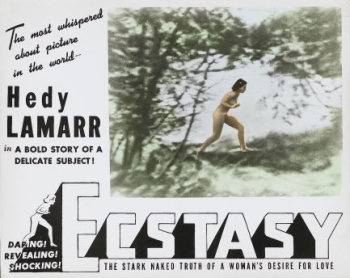 From
the beginning, Hedy claimed there had been no nudity or overtly intimate
scenes in the script, and she was herself surprised to see her bare body
parts on screen (when the director had assured her the camera was too
far away to capture anything but the most atmospheric silhouettes), as
well as to see the combined effects of the close-ups he had shot of her
face reacting when he stuck her with pins. Implausible as it may
sound by modern standards, the credibility of Hedy's naïveté was
supported by the fact that she took her parents with her to preview the
film and the whole family walked out of the screening together.
From
the beginning, Hedy claimed there had been no nudity or overtly intimate
scenes in the script, and she was herself surprised to see her bare body
parts on screen (when the director had assured her the camera was too
far away to capture anything but the most atmospheric silhouettes), as
well as to see the combined effects of the close-ups he had shot of her
face reacting when he stuck her with pins. Implausible as it may
sound by modern standards, the credibility of Hedy's naïveté was
supported by the fact that she took her parents with her to preview the
film and the whole family walked out of the screening together. These pages
are still under construction.
These pages
are still under construction.| Now in Print! |
|---|

| Now on DVD! |
|---|
Buy Videos & DVDs |
|
Buy Movie Posters |
|
Buy Movie Posters |
|
Classic
Movie Merchandise |



|

|
 Printer-friendly version.
 Return
to the top.
Return
to the top.
Last updated:
March 10, 2011.
Reel Classics is a registered trademark of Reel Classics, L.L.C.
© 1997-2011 Reel Classics, L.L.C. All rights reserved. No
copyright is claimed on non-original or licensed material.
Terms of
Use.